After I had written the poems in Town for the Trees, and established it as a manuscript. I could hardly conceive there would come a time when I would (or even could) write more poems about my home town of Springville, Utah which would be truly new. I felt there was no way for me to continue to use the town as a primary character in my poetry because I had written more than 50 or 60 poems about the town, and some 46 of those poems made it into the final version of the book. There was just no way I could do it. What I discovered is what happens after you write everything you think you can write on a particular subject. What I did was write more poems. A lot more poems.
My new manuscript, titled Hobble Creek Almanac, is another book written entirely about my home town of Springville. As it stand right now, it's 44 poems and 74 pages of actual poetry. That size will increase by about two poems. Yes. One year after my first book was published, I have another, entirely new book of poems ready to go. None of the poems written at the time I was writing my first book made it into this latest manuscript. Those are the poems which made it into the manuscript. As with my first, book, many poems did not make the final cut.
So how did this happen? How did I go from not thinking myself capable of writing any more poems about a place to writing an entirely new book? A few things happened which I think are relevant. To start with, the poems I wrote for the first book were literally written over the course of a decade, and if anything, I am minimizing the time I spent writing them. The other thing that happened was writing the first book expanded my scope, even if I wasn't immediately able to recognize it.
That scope which grew over the course of more than a decade. Just like when I first started writing my poems back in college I did not realize I was in fact planting the seeds of a book length manuscript, I did not see the work in writing and shaping a book length manuscript for the preparation it was establishing for another book. That took a while. My next project, after Town for the Trees, was a deeply jarring and disturbing manuscript, touching on all sorts of personal issues, which was unlike anything I had previously written. It was a book of landscape poetry, but those poems were about my emotional landscape, the alienation between father and son, the loss of identity. To say I was exorcising some demons from my system is certainly a safe and easy to prove statement. Little did I realize while I was writing that book (which may or may not ever see the light of day in published form) my mind was at work on this second manuscript, contextualizing the world in terms of what I knew could still be said about my home town.
In this latest book, I began seeing a book expanding the history of my town, not merely the simpler themes of loss and separation explored in my first book. Not that those themes are neglected in any way with my new book, but there is more to it. I also had to let go of quite a few preconceived notions regarding the structure of what my original intentions were. I doubt I would have been able to write this second book about my home town without the experience of writing the first. Why? because the experience of writing the first one informed me about structure.
You see, at first I thought I needed to write longer narrative poems to tell the stories of specific people and families from my home town. I thought that would be the way to tell the history of my town. The only real problem is I was wearing blinders as to the way to frame those narrative poems, based upon my mentor Dave Lee. For anyone familiar with his work, you know what a masterful poet Dave is when it comes to the narrative poem. I doubt anyone does it better than him, especially when it comes to his ear. For a very long time I thought I had to write those sorts of poems, or poems like B.H. Fairchild---these expansive and sweeping descriptions, but I was wrong on both counts. After struggling through a few failed attempts, I realized I had to make the poems mine. And though you can hear hints of both Lee and Fairchild in my poems, the poems in the book is according to my own set of values within the narrative structure. Coming to know I had that capability is the groundwork laid by writing the first book. All of these poems in my head just waiting to come out were waiting for me to write them.
So what process did I use? I found a structure first. My first book had no sections. This latest book has three. The first is about the first few years of settlement. The second is structured as a series of persona poems, meant to be internal and external poems written by a real life-long resident of Springville. It was important that I chose a person who was not my relative. This connects back to the very real need of needing the ability to tell the truth and the freedom to lie. I need to be able to tell the truth and lie certainly within the same book, and quite possibly within the same poem. I needed to have a person/family to tell real stories and have them sit next to those I have fabricated entirely. The third section is me trying to answer the difficult question of why my home down has such a strong hold on me. I say difficult because I did not have an easy childhood or adolescence in my town, yet I am deeply in love with that place.
I also was lucky ( I mean the hybrid of inspiration and preparation often associated with creative thinking) because family and town history is a passion held by quite a few people I know, including several relatives. This meant I had access to books and documents not readily available to t5he general population which created several of the pathways as how to best lay out such a writing project such as this one. I may not have told the stories I initially thought necessary or even related many of the details some people might think essential to writing such a book as the one I have, but I was in fact able to create a document I am proud of.
Then there are the footnotes and epigraphs. Because I have always been a fan of the epigraph, there are plenty of them to be found: Two for each section, and a lot scattered throughout the book. Some are real and some are not. Some of the footnotes are real and some are not. This was essential for my process because again, I needed to feel free to walk in and out and even dance on the line between truth and lie. I was not retelling a history, I was recreating a history. And if any of you cannot conceive of a book of poetry filled with lies mingled in with truth, t hen I have to wonder why you are even interested in poetry at all.
I will tell you now in all honesty (you can trust me here) I was surprised by finishing the manuscript so suddenly. Again, I think I have two more poems to be written, but I really did think up to about a week ago, I would still be making more poems for this book up until December, and have about 10-15 more pages than it does. I was taken aback by the completeness of what I had, but everything felt right in the construction and in the length. I know better than to keep pushing when things feel this good. Now I still have plenty of work to do. I am certain I will have a lot of revising to go through when my readers get finished picking the book apart, but the drafting is practically finished and I believe the biggest challenges are behind me, save the one where I get other people to believe in the manuscript enough to want to publish it. If anyone has that one figured out, I'd like to know about it.
Monday, September 10, 2012

Saturday, August 25, 2012
Theoretical Statement One
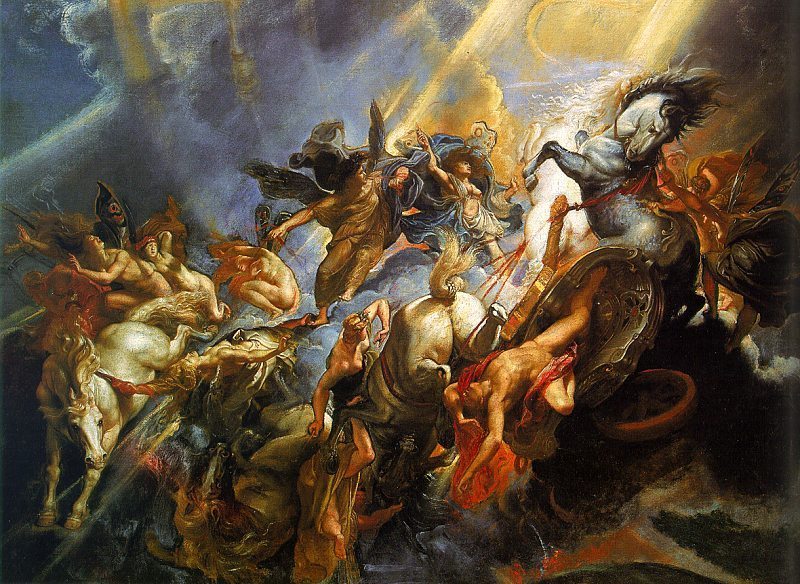
Poets do not write truth. Poets do not reveal truth. Poets manufacture truth.
Most poets probably hope this manufactured truth comes close to the actual truth, or perhaps even so closely mimics authentic truth it becomes indistinguishable from authentic truth to the casual observer, but it is not truth at all. It is nothing more than dressed up fiction. Poets may indeed want what they manufacture to become real truth, but that is a folly each and every poet buys into on day one. All poets are busy creating a mythology hoping it will some day be classified as religion.
Friday, August 17, 2012
No More Contest Result Blues for me
Just to be clear. I have not won a book contest. This post is about why I won't be entering book contests for a very long time.
I won't be entering my manuscripts in contests this academic year, and quite possibly for a very long time after that. Does that make me evil? Does that make me a bad person? Does that make me come off as somebody who thinks his shit doesn't stink or someone who thinks his poetry is just too *something* the presses won't get? I don't know. So for those who are able to write enough poems every year to always have a manuscript in play in the contest circuit, I am dropping out---not that any of you looked at me or my manuscripts as a threat.
I won't be entering my manuscripts in contests this academic year, and quite possibly for a very long time after that. Does that make me evil? Does that make me a bad person? Does that make me come off as somebody who thinks his shit doesn't stink or someone who thinks his poetry is just too *something* the presses won't get? I don't know. So for those who are able to write enough poems every year to always have a manuscript in play in the contest circuit, I am dropping out---not that any of you looked at me or my manuscripts as a threat.
I am not submitting my completed manuscript and I am not
submitting my near completed manuscript to any book contests this year for some
very obvious and some not so obvious reasons.
Here are a few I feel okay sharing with you.
1. I have already
sent my completed manuscript, Sailing This Nameless Ship, to every contest I
care to send it to, and having been soundly rejected every time without so much
as a comment or reaching a single "semi-finalist" (let alone
finalist) benchmark, I have come to the conclusion that yes, I am writing
poetry nobody wants to commit to at the book level. Is it really bad poetry, or is it a matter of
taste? I would like to think it's a
matter of taste, but I have to accept I am simply not that good of a poet. So for now, and for a long time to come,
Sailing This Nameless Ship is off the market.
2. I do not have Life-supporter's
Guilt. I buy plenty of books, and have
on at least three occasions, bought a press's entire catalog of chapbooks. I do not feel a single stab of guilt or
remorse when presses take time out of their day to tell me about how they are
on the brink of disaster. Want to read about
disaster? Go read about Foothills Publishing. Michael Czarnecki's house burned down, with
his entire inventory and a lifetime of private journals. If I like your books, I will buy them. I am just not really that enthusiastic to
support your press via contests I have absolutely no chance of winning.
3. I have absolutely
no chance of winning 99% of the contests being conducted in the poetry
world. I don't write the kind of poetry
which book contests want. Presses who
run book contests are looking for poets and poetry which will elevate them in
status. Contests want poetry and poets
who are edgy, insinuate themselves into the conversation. I am fine with the background. My poetry is quiet for the most part, stays
on the surface, doesn't play well with the established arc of contemporary
poetry. No, I am not claiming to be an
innovator or some misunderstood genius. For the record, I am a competent poet at
best. I stand on the shoulders of
giants, and if I get credit for anything, it might be in my choice of whose
shoulders I stand upon to create my poetry.
I hear the word 'shallow' a lot, but I really don't care because it's
really the only way I know how to write my poems, and I am fine with that.
4. I don't feel like
participating in the whole Reader Screen---Judge Round---Ranking euphoria
contests support. Did I make the
cut? Did my manuscript make it to the
semi-finalist list? How long will it
take to hear about the Finalist list? Is
the rumor true---will they be publishing a second manuscript off the list? Let's face it. There is a weird vibe with poets. We have a difficult time knowing our friends
are our competition in some ways, and book contests have that in spades. I can't count how many times I've had cryptic
conversations where poets I know have been trying to find out whether I have
sent a manuscript to this place or that, or have been trying to somehow keep me
from learning about a certain contest. I
am already a little bit too manic when it comes to this I am just better off
not asking all of the other questions which comes after those I just listed,
the biggest being, Why didn't I get at least a mention on the semi-finalist
list?
I'm finished for a while.
I want to give my new manuscript the opportunity to breath a while on
its own and give it a chance to go through open submissions and
rejections. And here you thought I was
going to talk about contest fees being too expensive. Silly Rabbit.
Friday, August 10, 2012
Book Review: Amanda Auchter's The Wishing Tomb

The Wishing Tomb
Amanda Auchter
88 pp., Perugia Press
ISBN: 978-0-9794582-5-5
$16.00
As a matter of course, I like to disclose my relationship
with the author of the book I am reviewing.
I find it easier than trying to explain later how and why I came to
write a positive review (you should all know by now I do not write negative
reviews) for the book. Too many people
for my comfort try to make some sort of nepotistic connection, as if I expect
the author in question to support my work in return of a favorable review. That just isn't so.
I have known Amanda Auchter, or rather, I have had dealings
with her since her early days editing Pebble Lake Review. Amanda graciously accepted several of my
poems for that publication, and those acceptances came at a point in my writing
life when that acceptance made me feel as if a burden was being lifted off my
shoulders. Since then, I have followed
her presence on line and of course now with the advent of Facebook, I have come
to see pieces and fragments of her personal life, which always adds depth to my
understanding of the work.
When setting out to write a book so focused on a theme, as
The Wishing Tomb is, the reader comes to the book with certain
expectations. The reader expects to read
about the topic at hand from the writer's perspective. One expects certain sensibilities and perhaps
the reader will rely upon past experiences with other similar projects. When I heard the book of poems focused on the
history of New Orleans I have to admit I was expecting something akin to B.H. Fairchild's
work. I was expecting more history than
lyric, more sociology than image. I am
not saying Fairchild is lacking in these areas, but he does cut a wide swath
with his poetry, and when I began to read The Wishing Tomb, I found something
much more personal.
From the very beginning of the book, Auchter reveals her
command of the single line of verse. Her
fragmented stanzas and lines is one of the best examples of confidence I have
seen in any of my recent reading. She is
able to allow these utterances to stand by themselves, linger, and worm their
way into the mind of the reader. When I
read the poem "Casket Girls," early on in the book, is when I
realized I was in for something really exciting. In a strangely anonymous persona poem,
Auchter announces her intent on diving deep with the reader in tow.
We thought the water
would never
end. Dark pools of stars
in our faces―
Auchter spend the
rest of the first section floating in and out of various persona poems and
omniscient observation, slowly transitioning into poems constructed with beautifully
written couplets and amazing single lines.
"American Plague" is another must-read-again poem in the first
section of the book.
Throughout the book, Auchter provides a roving pastoral of
the city and its various places. While
these locations may be familiar to those who have knowledge of the city, the
poet is able to bring a relevance to the reader (such as myself) who has no
experience with the city. For those
unfamiliar with New Orleans, there is presented here simultaneously the city
everyone knows and the city only the poet can describe. The opening lines of the final poem,
"Late Pastoral" read:
How beautiful this
was in the beginning:
white mulberry, Indian
corn, a source
without suffering,
without crime.
The blue-white wall
of sky above us
and nothing for miles but water,
duckweed, Tupelo
gum. It is April . . .
By the end of the second section, Auchter has painted a
mural of the city's history, both of familiar and obscure events. I want to meet the characters and people
behind these poems. Here in the second
section the reader finds the title poem.
It's straightforward address, as it takes the reader through a series of
traditional/folkish rites, is a reminder of New Orleans' magic, that in this
city, "Everything// becomes possible."
If anything is predictable in this collection it is we know
the third section will address the recent events and struggles within New
Orleans. However, by the time you have
read the first two sections, you are prepared to enter the third section having
a richer, more complete sense of what New Orleans is---certainly more informed
than what many other writers provide when they write about Hurricane Katrina. In fact, The Wishing Tomb can serve to inform
most every other poem written about Hurricane Katrina. And being able to inform
readers for an entire topic and specific subject matter is a wonderful side
effect to contribute. Here,
"Fragments of an Aftermath" challenges conventional views of what
happened in the weeks following Hurricane Katrina.
The Wishing Tomb is Amanda Auchter's second book of poems
and as a poet I envy her confidence and command of the line; however, that
isn't why you should read this book. You
need to read this book because it is wholly American in its focus and
devotion. You need to read this book
because Auchter has created something whole, complete, and compelling. You need to read this book so you look
beneath the surface of New Orleans with rich and daring language taking you by
the hand and leading the way. The Wishing Tomb will not---cannot disappoint.
Thursday, August 9, 2012
I am for Civil Rights: Why I don't accept the argument of those who oppose gay marriage
This post is written with the specific intent of being posted on Facebook.
Let me be very clear from the start. I am in favor of gay marriage, and if you do
not like it, then you have a choice to make.
You can state your opposition, you can remain silent, or you can simply
stop being my friend. Here's why:
1) Gay marriage is
not about a feeling to everyone. For
some of us (most importantly gay men and women) it is about civil rights. It is about the 9th Amendment and the 14th
Amendment. If you choose to ignore those
parts of The Constitution then you must at the very least accept you are in
favor of legalizing discrimination. It
is discrimination just like it was discrimination to limit the rights of
African-Americans. And before you go
there about choice versus nature, you know you are not going to get anywhere
with that. If homosexuality were a
matter of choice, it would still be discrimination. How?
Criminals make choices we don't agree with, and they are still afforded
marriage rights. There are approximately 1400 Federal and state laws regarding
marriage, which ignore or are written to be prejudicial against so-called civil
unions, partnerships, and common law relationships. What other 'feelings' present such a wide
range of discriminatory laws? Further along the spectrum you must also accept
the contradictory nature of religion in the U.S. More specifically, I will ask you a question
to illustrate my point.
Why is it okay to erode the separation of church and state
(in order to promote your religious philosophy) which would limit the rights of
people with views in conflict of your own, but at the same time be wrong to
expect religious organizations to pay taxes and adhere to a single, specific
interpretation of religious values? Of
course you know the answer. The first
Amendment states no laws be enacted to discriminate against religious
beliefs. It also states by way of legal
reciprocity that religions cannot dictate laws in the civil realm.
2) Gay marriage does
not interfere with your ability to practice your religion or your life in any
way. How many people have been displaced
because of gay marriage? How many people
have divorced or found themselves unwilling to marry in states where gay
marriage is allowed? How many churches
have been destroyed because of gay marriage?
There has not been one single piece of evidence to prove any
heterosexual person or couple who has suffered because of a gay marriage. And don't give me that old, "My cousin .
. ." , or "My friend in Kansas . . ." bullshit, either. That old standby is pure myth and is all too
often linked to purely fictitious propaganda.
3) Your values are
YOUR values, and in matters of civil rights, have no place in the discussion.
I am not going to change your mind, and you are not going to
change mine. Too many people who are
against gay marriage continually bring up their "feelings" and
feelings tend to be immutable. Opponents
to gay marriage do not rely upon facts or legal issues. They base their opinion on religious texts
and incorrectly assume several things
a)They
assume the Bible is meant to be taken literally, when the literal
interpretation of the Bible is a 19th Century convention.
b)They
cherry pick the arguments they want to make and say those parts of the Bible
are meant to be lasting while other laws of Leviticus are simply guidelines
relevant only to the Ancient Israelites, which is obviously hypocritical.
c) They
assume everyone should accept and follow the same interpretation of the Bible,
which is virtually impossible and contradictory to the Constitution.
d) They
assume the Bible should continue to be the basis for law in this nation, which
is not only secular in nature, but is the very model of secular humanism from
the period of Enlightenment, where people all around the world dreamed of a
nation unfettered by the reach of religion.
This point is important because the vast majority of Christians believe
the U.S. was founded by the auspice of God.
It cannot be both a secular nation to protect religious freedom AND a
godless nation in need of religious rule.
4) I am sick and
tired of people saying they don't "hate" anyone. Well, my wife said it best when she said,
"You may not hate anyone, but you certainly don't like gay
people." That's the truth. I am just extremely tired of people trying to
justify their bigotry with their version of theology and rhetoric. I get it.
You are opposed to gay marriage and you want us all to believe there is
no hate in your hearts or minds when you support discrimination on this level and
remain silent when it comes to gay bashing and violence against gays. I get it.
We all get it. I'm just not
buying it. Go sell it somewhere
else. Go sing it on the mountain, for
all I care. Just don't pester me with
that idiotic justification any more. The simple truth as I see it is you are not in favor of some people having the opportunity to share their lives in a marriage and be equal to you. Privately you can believe that, but in a pluralistic nation such as ours, your personal views should not be allowed to interfere with the rights of others.
I am standing my ground, so you have a choice to make. I will accept every choice you do make, but
you need to stop insisting I accept your arguments because there is nothing
left to argue in my mind. Accept my
position (and all of its implications); reject my opinion and my arguments; say
something or remain silent; decide to end our friendship. It's your move, and I don't care if you think
I am being ignorant or passive aggressive.
This is my position and I am not moving from it.
Tuesday, July 31, 2012
Question
I have a serious question. I want to know how much poetry is tied to popularity and fad. I am asking for some very serious reasons.
1) Collin Kelley has stated "good" is a matter of taste.
2)Anyone who denies the increase of poems placed before the first section (in what always seems to be a three sectioned book) and "Notes" pages in books, is just lying to make friends.
Which leads me to ask: Why does it appear manuscripts are being chosen as if they have been matched up against some sort of checklist?
Three sections? Check
Poem with personification of some exotic animal? Check
A Notes page to explain regional or colloquial language? Check
One poem at the beginning of section three which "breaks" the mold? Check
At least two ghazals? Check
One poem about god which does nothing to clarify the poet's position? Check
Not so Subliminal nod to Bob Hicok? Check.
. . . well, you get the point.
* * *
I am being serious. Why? Because I am writing yet another manuscript of landscape meditation, and I really am having a lot of fun writing it and quite proud of the poetry in it, but that will only get me so far if there aren't any editors out there who enjoy these poems, too. I know going in I've got a fight on my hand, but it would make things a lot easier inf I could figure out what's going on.
When I write poems about pop culture and contemporary themes, I get a lot of poems accepted for publication, but when I write these landscape meditations, I go for months without any good news from editors. I don't want to simply aim my writing where I know it will hit the mark and be accepted. I want to write the poems I know which need to be written. It just feels like what my wife said to me. She told me what I am writing is simply not in style right now. Now, I know I am no Wendell Berry or Dave Lee or Gary Short, but I can and do hold my own, and I do know a thing or two.
So, my original question stands. How much of this thing is popularity and fads? Am I just not finding the right venues? What am I missing?
Sunday, July 8, 2012
Hobble Creek Review is now Up!
Hey, everyone! Come on over to Hobble Creek Review and have a read. Our latest issue is up and ready for everyone to have a look! This issue features the following poets and writers:
Carol Berg
Will Cordeiro
Marilyn Haight
Ruth Huber
M.J. Iuppa
Kathleen Kirk
Mercedes Lawry
Leny Lianne
Linda Martin
Corey Mesler
Mark J. Mitchell
Kimberly O'Connor
Andrew Shields
Lauren Tivey
Steve Wheat
Scott Wiggerman
* * *
I would also like you to consider submitting for our next issue, which is going to have a special section edited by Jeff Newberry, focusing on the Gulf Coast region. So come on over and stay a while. Pass the word if you read anything you like, and as always, let me know which poems in particular you like so I can pass on the word to the poets. Hearing good things about one's writing is always helpful.
Saturday, June 30, 2012
What Bothers me (At the Moment)
A little while ago on Facebook, I asked for anyone wanting
to debate me over the issues relevant to what has been going on in the world
over the past few days, they do the following:
1. Bring facts, not rhetoric.
2. Organize your thoughts.
3. Learn how to stay on subject, and stick to specifics as
opposed to generalizations.
4. Learn the basics of the more common logical fallacies.
I even provided a link to the skeptics guide.org, to read
about common logical fallacies.
So why and I harping on this again? Because I ran into
a Ron Paul Supporter who came up with 26 reasons why President Obama is causing
the downfall of the United States of America. That's right.
President Obama is single-handedly responsible for America's downfall.
Now before I list some of these gems of so-called political
facts (most were in truth rhetoric) please let me be clear about this: I
am very much in favor of the loyal opposition. I believe it is only
natural to have political diagreements with their leaders. I had them
with President G.W. Bush and his administration, and I personally know a lot of
people who do not agree with President Obama. I am okay with that.
However, I am not okay with what is going on with most of the discussion
about President Obama conducted by the most vocal conservatives.
For one, when trying to explain why President Obama
represents the downfall of the U.S., it's best to avoid listing things the
President did not accomplish, which you were against in the first place.
I am supposed to see your point, that the President, is for all intents
and purposes, the worst thing for the U.S. because the President failed to do
things you were against in the first place? How does that work?
For another thing, why is it whenever I ask for facts and
figures, most of what I get is rhetoric and political bias? We all know
statistics can be manipulated, but they are a baseline, which promotes debate.
All rhetoric accomplishes is to burrow one's self deeper in, like a tick.
If you make a claim, give a source. And by the way, I use quotes
because I like the ideas behind them, but I do not use them as factual evidence
and support for my arguments beyond demonstrating how other people think.
How is it you can trust your sources? Look them up. Do a
little digging. I realized a few days ago why talking about all of this
stuff makes me so tired. I try and do research when I bring up a point.
When somebody provides a quote or a "fact," I look it up
to see the quote in context. I read about that "fact" and try
to see where else it leads. I get criticized some times because it takes
me a while to compose my response. I have been told on more than one
occasion I must be "reaching" or grasping at straws because it takes
me a long time to respond. Well, 1: I am doing the work, and 2:
I am a poor typist. Some people need to learn that a well thought
out, reasoned response is a good thing, not a show of poor critical skills.
So here is a sampling of a few reasons why President Obama
is the "downfall of the U.S." f anyone wants the complete list
(because I don't want anyone claiming I am just cherry picking here, send me a
private message and I will send it to you as soon as possible.
1) Poor reaction to the BP Gulf Spill
2) Extending the Bush tax cuts
3) Guantanamo is still open (which I do think is
disappointing)
5) Failure of the DREAM Act
14) Attacking John Boehner for smoking, even though Obama
himself is a smoker
16) Giving a half a billion dollars to Solyndra, only to see
them buckle up within a year
18) His $800+ billion stimulus, which was supposed to keep
unemployment at seven percent, has not stopped it from rising to 9.1%
19) His $450 billion jobs plan is supposed to create a
million jobs. Do the math, and that means government will spend $450,000 PER
new job created. The private sector can hire ten workers for $450,000 -
government possibly, perhaps hires one - maybe, and then only temporarily. Once
the road or bridge is built, the worker is laid off. Herbert Hoover tried the
same thing, using public works projects to spur employment - guess what, it
didn't work. The Great Depression got worse.
21) Wasting his first two years, with Democratic control of
the House and Senate, on a controversial health care reform bill that
squandered his popularity. He might have been better served to focus on the
economy!
25) Having a cabinet and advisers full of people who do not
pay their taxes, and who talk about the inspirational speeches of Mao.
26) One of his first acts as President over-turned the
Mexico City policy, allowing the federal government to fund abortions performed
in other countries. He enters office with an economy going over the cliff, but
priority number one is opening federal funding to abortions performed overseas.
That is not exactly my idea of getting our financial house in order.
* * *
This is what I am up against. Where do you start? When one side is tacitly allowed to list rhetoric as arguments without fact checking or providing sources, it gets annoying. With a list of 26 items, it feels like some poor attempt at presenting what is hoped will be a wall of insurmountable arguments.
I responded to all 26 in kind, with what I hoped was logical rhetoric, but it's time to start rejecting the premise of these kinds of so-called arguments without real evidence to back them up. It's time to make these kinds of conservatives do the prep-work themselves.
Tuesday, June 26, 2012
How I Know I am a Poet
All of my writing life I have been constantly leaning to one extreme or the other regarding my status as a poet. Am I a poet, or am I a person who happens to write poetry. Is one of those things better that the other? Well, I am not going to be trying to answer which is better, but I am going to try and explain why I am in the camp I am in: That of being a poet.
First, I need to say I am not a poet because I read poetry, nor am I a poet because I read a lot of poetry. No, there hasn't been some sudden explosion in the numbers of people who read poetry for the love of reading poetry, but I think it takes more. So am I a poet because I write poetry? Some might say yes, or at least say writing poetry is a definite step in the right direction to becoming a poet. Still, writing poetry is not why I currently believe myself a poet. Here then are a few reasons why I am a poet:
1. Poetry gets more difficult for me to write every day and I am still in love with the idea I can some day write a perfect poem.
Why does writing poetry get more difficult? Because every time I come to poetry something has changed, like my understanding of poetry and like my expectations of myself and what I want poetry to give me. You see, the more I know about poetry, the more I have to hold myself accountable for what I write. I am still going to write terrible and awful poems, but the more I know about poetry, the more time I spend making sure I am doing everything I know to make the poem right. The more time I put into that activity means the more I expect from myself. I don't want to keep making the same mistakes over and over, especially when I should know better. The more work I do, and the more I expect from myself adds up to my wanting more from poetry. I want poetry to continually surprise me, and I want my poetry to be the kind in which I can delight. The it starts all over, because the more I expect from poetry means I am forced to learn more about it so I can be prepared to come to poetry with my very best efforts.
2. I literally hear many of my poems. They come to me (either in fragments or complete) at the most odd moments and I instinctively know there is only one thing to do with them---write them.
It's as simple as that. You may not think anything of it, but I strongly believe there is some sort of mystical connection where creativity is concerned. Do not make the mistake of equating intelligence with creativity. I think creativity is both a component of intelligence and an independent agency, operating somewhere in the human mind. For those of you who are scientifically inclined, think about the spooky nature of quantum connectivity. There is something bigger at play with creativity (and my poetry, specifically) than simply the mechanical work involved.
When I fail to write one of the poems which come to me (and not all of them come to me in the way I described above) I feel as if . . .no, I know with a certainty I have wasted an opportunity. How big an opportunity I cannot say because it is impossible to compare something which exists to something which does not. All I know is I feel as if I have let something, a part of me go, which can never be retrieved.
3. When I write a poem, I feel more than just good.
When I write a poem, even a mediocre poem, I feel as if I have slipped into some concrete, real groove. I feel a sense of relief. I feel in tune with the universe because for a brief moment, I am literally in the right place at the right time. To add to that, so few things in my life make me feel that way. It's poetry, family, teaching, and a few friends. That's it. Nothing else comes close on such a consistent level.
Other poets know what I am talking about---any artist does, too. The universe slows down for a few moments and there is a real sense of belonging, as if one's place in the universe is assured and acknowledged.
There is also this: Wen I feel like I do when I have written a poem which works, I am taken back to my first reason. I want the challenge of having that feeling again, knowing the whole time it will be more difficult than the last time, and that I will more than likely be beaten.
Do you know what? It doesn't matter. What matters is I keep coming back, and that's why I am a poet and not somebody who happens to write poems.
Thursday, June 21, 2012
More of the Same
Right now I am thinking about books. My books. Not the books I have written, but the books I am writing. After all, in the writing world, it's not what you have written, but what you are writing. Remembering that has on more than one occasion pushed me into creating some really fine writing.
I am talking specifically about my manuscript, Sailing This Nameless Ship, and my current manuscript in progress about my home town of Springville, Utah. Now, I know on some level you are sick and tired of listening to me talk about these two projects, but this is part of my process. So if you've had enough of me talking about them you should feel free to leave this blog.
* * *
Recently I received some really good notes for Nameless Ship. A poet friend read it for me and gave me some really wonderful advice and specific edits. I have already made a lot of those changes and I have to sit and think regarding the others related to structure. One suggestion is regarding making a longer poem out of a series of themed poems. If I do that, the entire structure of the poem needs to be changed. Now I am not opposed to changing the structure. In fact, I am more nervous about the prospect of a long poem than I am about the restructuring of an entire manuscript. I realized my fear while reading Sandy's post on the subject. I am not a long poem kind of poet, and I am always afraid the wheels might fall off the poem and losing the reader as a consequence. I have written very few long-ish poems (which are not long at all) and every one of them makes me nervous.
I also have to get used to the idea I need to start submitting it again. I need to bite the bullet and start researching presses again and sending it out for consideration. No matter how I try, I can't blindly submit this book to every contest under the sun. I will also be honest when I say this book is a strong candidate for a self-publishing crossover for me. More than a third of the poems have been published in journals, and one was actually nominated for Sundress Best of the Net. There are a few small prosy bits I still need to fix, and I will give presses another go around. However, if I find no joy (hereafter defined by any positive feedback, not necessarily acceptance for publication) I am going to learn a few things from people I know about the process of a good book experience at Lulu, and do it up right myself. It isn't a lack of patience, either. I need to get the manuscript out of my system. I need to find out if I wasted more than a year of my life. Well, that's not entirely accurate. According to most of the known universe I did waste m time. It's not about fame, either. Here's what I have to say about that:
My Springville book is coming along. I haven't written new poems for it in the last week or so because I have been trying to write songs as lyricist for a group started by a couple friends. Boy, and I a terrible song writer! I finally penned a Scott Walker clone, though it's probably a clone of the guy who Scott Walker covered extensively in his first two solo albums. I forget that guy's name.
I really am making progress, though. I have 33 poems written and a solid picture of what the book is supposed to look like in its finished form. My one hindrance still remains: The narrative poem. Some days I lie to myself, claiming my short, lyric poems weave a narrative tapestry, which serves to tell a story, but the fact remains I cannot write a decent narrative poem to save my life. Lord knows I have tried, but I cannot get blood out of this old turnip, and I really should stop trying because it is rather embarrassing to watch.
Still, I shouldn't have problems getting this book published eventually. A lot of people tell me I am lucky to have the people at Foothills Publishing, and they are right of course, but I will be submitting it elsewhere, too. With four books out from Foothills already, I do not want them to think I can just send them anything and they will jump to. My biggest obstacle with this manuscript so far, has been a universal lack of interest in any of the individual poems I have been sending out. So much so, I have actually stopped sending any of them out to anyone. That is, until I can finish more of the poems which are supposed to be in the final section of the book. The fact is the first two sections of the book are very much like a concept album (strictly for the analogy because as I stated earlier, I am a terrible song writer) and the appeal is not entirely there. I don't want to give too much away too soon, but the closest structural element to a traditional book of poems this manuscript comes to is it's three primary sections.
* * *
Well, that's enough from me. You've all got better things to do I'm sure.
I am talking specifically about my manuscript, Sailing This Nameless Ship, and my current manuscript in progress about my home town of Springville, Utah. Now, I know on some level you are sick and tired of listening to me talk about these two projects, but this is part of my process. So if you've had enough of me talking about them you should feel free to leave this blog.
* * *
Recently I received some really good notes for Nameless Ship. A poet friend read it for me and gave me some really wonderful advice and specific edits. I have already made a lot of those changes and I have to sit and think regarding the others related to structure. One suggestion is regarding making a longer poem out of a series of themed poems. If I do that, the entire structure of the poem needs to be changed. Now I am not opposed to changing the structure. In fact, I am more nervous about the prospect of a long poem than I am about the restructuring of an entire manuscript. I realized my fear while reading Sandy's post on the subject. I am not a long poem kind of poet, and I am always afraid the wheels might fall off the poem and losing the reader as a consequence. I have written very few long-ish poems (which are not long at all) and every one of them makes me nervous.
I also have to get used to the idea I need to start submitting it again. I need to bite the bullet and start researching presses again and sending it out for consideration. No matter how I try, I can't blindly submit this book to every contest under the sun. I will also be honest when I say this book is a strong candidate for a self-publishing crossover for me. More than a third of the poems have been published in journals, and one was actually nominated for Sundress Best of the Net. There are a few small prosy bits I still need to fix, and I will give presses another go around. However, if I find no joy (hereafter defined by any positive feedback, not necessarily acceptance for publication) I am going to learn a few things from people I know about the process of a good book experience at Lulu, and do it up right myself. It isn't a lack of patience, either. I need to get the manuscript out of my system. I need to find out if I wasted more than a year of my life. Well, that's not entirely accurate. According to most of the known universe I did waste m time. It's not about fame, either. Here's what I have to say about that:
Being a famous poet is like being the most popular member of an AA meeting without all of the perks, like stale coffee and regimented sobriety.
My Springville book is coming along. I haven't written new poems for it in the last week or so because I have been trying to write songs as lyricist for a group started by a couple friends. Boy, and I a terrible song writer! I finally penned a Scott Walker clone, though it's probably a clone of the guy who Scott Walker covered extensively in his first two solo albums. I forget that guy's name.
I really am making progress, though. I have 33 poems written and a solid picture of what the book is supposed to look like in its finished form. My one hindrance still remains: The narrative poem. Some days I lie to myself, claiming my short, lyric poems weave a narrative tapestry, which serves to tell a story, but the fact remains I cannot write a decent narrative poem to save my life. Lord knows I have tried, but I cannot get blood out of this old turnip, and I really should stop trying because it is rather embarrassing to watch.
Still, I shouldn't have problems getting this book published eventually. A lot of people tell me I am lucky to have the people at Foothills Publishing, and they are right of course, but I will be submitting it elsewhere, too. With four books out from Foothills already, I do not want them to think I can just send them anything and they will jump to. My biggest obstacle with this manuscript so far, has been a universal lack of interest in any of the individual poems I have been sending out. So much so, I have actually stopped sending any of them out to anyone. That is, until I can finish more of the poems which are supposed to be in the final section of the book. The fact is the first two sections of the book are very much like a concept album (strictly for the analogy because as I stated earlier, I am a terrible song writer) and the appeal is not entirely there. I don't want to give too much away too soon, but the closest structural element to a traditional book of poems this manuscript comes to is it's three primary sections.
* * *
Well, that's enough from me. You've all got better things to do I'm sure.
Monday, June 18, 2012
The Rundown
1. http://www.huffingtonpost.com/2012/06/06/how-amazon-saved-my-life_n_1575777.html?ref=books
My wife pointed me to this article about the new revolution of e-book publishing. Among other things, it points to how the traditional publishing world is going to have to take a bite of a huge shit sandwich if they don't revise their tactics. And let's be honest, their tactics (or motives, sympathy, or interests) aren't very often in line with the author.
For example, this article relates to the inequality of the publisher when it comes to royalties and the process of taking advantage of the e-book revolution.
Collin Kelley has been talking about this for quite some time---how the self-publishing revolution has been revving up and getting ready to explode. Well, it's happening now, and if you don't want to believe it, then you are being willfully ignorant.
I really don't know how I will fit into the self-publishing/ e-book publishing world. I have a difficult time with doing everything myself when it comes to how I want my work perceived. I published a collection of my letters to Karl Rove by myself, but I really don't look at that as being serious. I did okay for a first effort. I occasionally read a typo or a phrase I would like to revise, but that's okay because I am not looking to make my name on that collection. However, I am hesitant to really jump in with both feet when it comes to my poetry. I'm pretty much old-school when it comes to my poetry, stuck in the adage "if it isn't good enough for somebody else to commit time and money for, then it isn't worth publication." But you know what? That's my shortcoming, my disability. It's also very un-American. I should be willing to put in the time and effort (I am capable) and then be willing to allow the market to make the distinction. of whether my work was worthwhile.
Another one of my doubts from being old-school, is the notion that I want to hold in my hands the real thing. I want to have a real paper, perfect bound record, and I will always prioritize that real book higher than any electronic file contained in an electronic reader. It isn't just that poetry formatting is in its infancy and takes considerably more work, it's the tactile sensation of a book. But again, that's my problem, and the distinction is shrinking every day in this age. Soon enough there won't be any of us left, and I have to be okay with that because it's going to happen until publishing is 98% electronic, and 2% print. I'm sure of it.
2. I have been asked to join with a group of musicians. I am supposed to be the lyricist, and my isolation is really a handicap. I am listening to music on Spotify to help me get in the mood, and I am talking back and forth via Facebook, but I am having quite a challenge translating my writing style into the style required for song lyrics. I like a challenge, but my biggest fear is to turn out to be a really shitty lyricist and being a lump of dead weight. I think I need to look up some information on song writing.
3. My own publication is in a real dry spell. I have not published a single poem in over a year, if my records are correct. My chapbook came out earlier this year, but I am having a real devil of a time getting any of my new poems published. Not a single poem from my latest manuscript has been picked up for publication and I have suddenly become gun shy when it comes to them. I am terrible at making assumptions. My biggest one is that with all of the rejections I have had, it is an indication other journals simply won't understand what I am trying to do with my manuscript, and that in order to 'get it' a person needs to see everything together. That, with the reality of running into so many roadblocks with my last manuscript (huge immediate success with individual poems but not even a second glance at the manuscript as a whole) makes me doubt almost everything I have written in the past four years. Maybe these book projects are the perfect time to jump into the world of self-publishing. Maybe . . .
Well, that's what is going on right now. I hope things are going well with you. I am still pining for a good old fashioned game of AD&D, and I am crawling ever closer to finishing that second book of Springville. I will let you know more as the weeks and months pass by.
See you on the flip side.
Wednesday, June 13, 2012
Credit Where Credit is Due
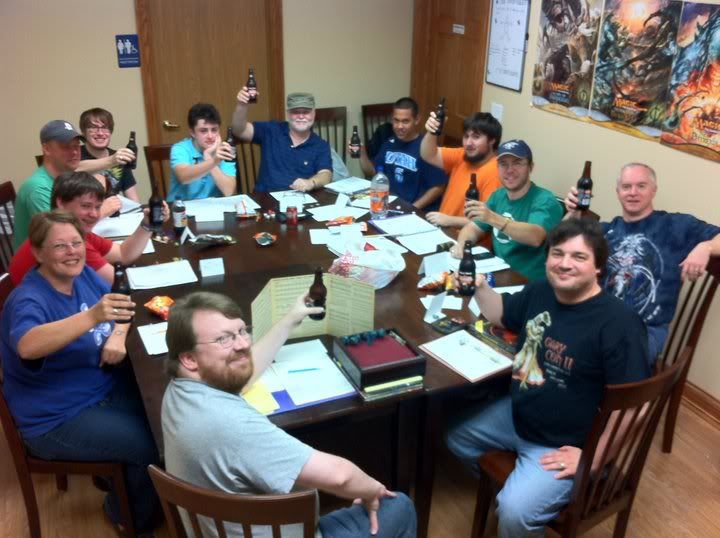
Tonight I am taking a few minutes to praise one of the unsung heroes of my journey as a poet. I have often talked about the books I have read, the other poets and writers I have admired, and the teachers in my life, bur I have neglected one area of my past long enough. That's right. I am talking about Advanced Dungeons & Dragons. That's AD&D for those of you who want to pretend to be in the know.
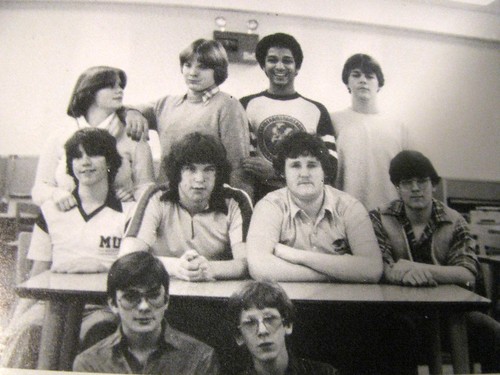
Then
(The only unrealistic aspect of this image is there is clearly a woman playing)
Now
(The only unrealistic aspect of this image is there is clearly a woman playing)
Now, I am being completely serious. AD&D gets a big portion of the credit for my desire and ability to write poetry. All through my teen years, while I slogged through the repetition of school and the outsider aspects of living in a rural Utah community, I was able to loose my creativity by way of fantasy and role playing games. As I look back, I firmly believe it was playing these games which stretched my imagination, giving me the capacity to explore poetry with both determination and curiosity.
I can hear some of you now:
But you don't write poems about the fantasy world. In fact, your poetry doesn't really play with language. How can you say playing a kick-ass game like AD&D helped you become a poet?
Well, I will cite Roger Waters from Pink Floyd. When he was asked about the band Radiohead as being the intellectual child of Pink Floyd (arguably one of the more experimental rock bands extant) he had the following to say: (I paraphrase)
"I listened to some of their music. My son gave me some to listen to, and I liked some of it, but there is a point where I turned it off and started listening to my Neil Young."
That's right. One of the greatest innovators in all of rock history listens to Neil Young. He was making a point, but the point is well made. Good music is still good music, regardless of its origin. With that in mind, I put it to you that any creative endeavor, regardless of its bent, is a positive influence upon creative efforts. I don't have to study Lang Po or the most adroit creators of intellectual poetry to get better as a poet, and just because I credit fantasy role playing games for my ability to write, it does not mean I must write within those confines. Think about Ron Silliman. Ron writes L-A-N-G-U-A-G-E Poetry, but how do you think he is able to critique other genres of poetry? That's right. He reads everything he can. It's the same for me.
* * *
My biggest regret is there are no other AD&D players in my small town. It has been years since I have had a chance to play a decent session of AD&D, and I fear it will be many more years before I can again, if at all. So Hail, Hail to the Dungeon Master, and all the friends from my youth who helped me then form the creativity and curiosity helpful to my poetry writing now.
Tuesday, June 12, 2012
Political Dirty Tricks: The Home Version
So, I just got
off the phone with a fundraiser working for Mitt Romney. I acted like a senile
old man (complete with voice and generational references), flubbed the credit
card number, and pretended to have an argument with my elderly wife,
Helen---all to waste the GOP's time. I took this fundraiser off the net for at
least five full minutes of b.s., and I feel so incredibly happy. Yes. I do this
kind of crap whenever I can and it is so much fun!
Becky handed me
the phone and I had a few seconds to get myself ready. Still unsure of how far I would take the
whole thing, I decided I would simply try to take the caller for a ride.
Now, you need
to know I have had this call before, and what the Romney campaign does is say
you can get a bumper sticker for $3, and then after you press "1" to
continue, ask you for $100-$200. That's
where I started.
What follows is
the best approximation I can recall as to how our conversation went. What surprises me most is the desperation of
the Romney Campaign to, above all else, hold on to this call in the face of its
absurdity. They must really be desperate for the money.
My Conversation with Mitt
The Players:
Fundraiser: Woman, college educated, mid-late 30's.
Old Man: Man, late 70's or early 80's. Married.
Voice similar to my grandfather's, but without the confidence and
swagger he had. Think of a man on the
verge of being diagnosed with the early symptoms of Alzheimer's.
Son: Belligerent, out of work basement dweller.
__________________________________
Scene: Late 1970's Ranch Home. Evening. The phone rings.
* * *
Fundraiser: Can we count on your support for a maximum
donation for $1-200?
Me: You just said the donation was $3. Why is it $100 now?
FR: The $3 is to get the bumper sticker. We . . .
Me:
(interrupting) I like bumper stickers.
FR: That's nice.
We are committed to getting Barack Obama out of the White House. With .
. .
Me:
(interrupting again) Good! My
grandfather always hated bumper stickers, but I like them. I have a lot on my car. I want one.
What do I have to do?
FR: Well, you
can give a donation by way of a credit card.
Master Card, Visa . . .
Me: (interrupting again) I have some of
those. Let me go get my Wallet. My wife has all of my things. She takes care of all of the bills. I have a Discover Card. Can you use a Discover Card?
FR: Any card is fine.
I set the phone
down to go get my wallet. I return. Read off the wrong number (of course) and
wait.
FR: There seems to be a problem with the
number. Can we read back the numbers
four at a time to see if there was some mistake? The first four XXXX. Is that right?
Me: Yes.
FR: The second four
are XXXX
Me: I read the right
numbers. I have excellent vision. I don't know why you'd think I can't read my
own card.
FR: No sir. You don't
understand. I might have made a mistake
typing in the numbers and I want to make sure I did my job right.
Me: Oh, Okay.
FR: The next four
numbers are XXXX?
Me: Yes
FR: And the last four numbers are XXXX?
ME: Yes
FR: And the
expiration date is XX/XX?
Me: Yes.
FR: (after a short pause)
The computer is coming back saying that is a bad number. Do you have one of those other credit
cards? We can use another one.
Me: That doesn't make
sense. My wife always pays the bills on
time. Let me go get another credit card
from my wife. She keeps all my
things. She takes care of all the books.
(off-line, but with the phone close enough for her to hear)
Helen! Where's my
damned Discover Card? I've got this lady
on the line and she needs . . . Did you forget to pay the bills again? The other card doesn't work . . . I need that card . . . I don't care!
Did you give our credit card to our son again?
At this time, I have to give a nod to my son Kaelan, who,
like a brilliant Improv Actor, came out and joined into the fun
Son: Dad! Shut up! Just stop yelling! I don't have your . . .
Me: (in the receiver)
I am going to have to call you back.
I've got a situation here.
END
* * *
Becky says she is never going to give me the phone again.
By the Numbers
Recently (well, last night) I talked about low acceptance numbers. I am sitting at an approximate 2.5% acceptance rate for the past 18 months. However, that's not the number which really bothers me. I have gone years without a publication, and in the past two years I have seen a full length book and chapbook come out from Foothills Press. I am, as far as books go, a very good run of it.
No. What bothers me is the fact I have not had a single poem from the new manuscript published. Not one. Not a single poems has appeared from the 32 poems I have written for the manuscript, and that is not good at all---under any conditions. Why? My usual pattern is to have great success with the individual poems I write but struggle with manuscript acceptances. Take for example, Sailing This Nameless Ship, my latest complete manuscript to sit in dry dock, so to speak. 37% of the poems in that manuscript were snatched up in a relatively short time. My acceptance numbers then were phenomenal. Where has the manuscript gone? To literally dozens of presses, and far more contests than I care to admit paying for. What has been the result? Nothing. No hyperbole needed. It has fallen on its face. I started sending out the manuscript in it's mature form more than two ears ago, and as each day passes, my biggest fear for it becomes one day stronger.
Now take my latest effort, a book of poems written about the history of Springville. Not an easy sell, but I pulled it off with Town for the Trees---twice. The big problem is it was difficult as hell to get that book accepted for publication, and that's with nearly every poem in that book having been published prior to being submitted for consideration as a whole. Here, I have been submitting these poems for more than a year as they get written and the one acceptance I received last year, turned into a rejection when the journal made the decision to focus solely on short fiction. No "we will still publish your work" or even more than a "sorry for forgetting you for eight months." My biggest fear is that I will get to the end of this manuscript, which is still 30 poems away from being finished, and have nowhere to shop it around because nobody will have seen any of the poems inside of it. They won't want it, either, because this time, nobody has wanted any of the individual poems within. It will represent another two years of my life, working on very specific manuscript, coming to nothing.
What terrifies me is I think I am getting better as a poet. If that is true, my getting better, then what is wrong with my writing? Maybe I need to start drinking.
Wednesday, May 30, 2012
Stress, in all its splendor
That's right. I am feeling the crunch of the last days of school. I've got finals to give, finals to grade, and I have been getting about five times the normal number of phone calls I normally get. (Just so you know, people at this school know not to call me for the hell of it because in addition to throwing me off my rhythm, it just really pisses me off to have my time wasted.) I am about to go nuts with all of this stress.
The only thing I can say I have accomplished, is all of my personal books are locked up in my cabinets. For those of you who don't know how this works, I have way too many books to clutter up my house, so years ago it was decided I would keep all of my poetry, history, and craft books at school, where I am much more likely to actually have a free moment or two to read on occasion. When I am working on a particular set of poems, I will choose two or three books to make the journey home each night, and then they get returned when I am finished. Every summer, I pick out a few books to take home with me and the rest get locked away until the new school year. If I am desperate, I can come down to the school to get into my cabinet. But mostly, if I want new poetry to read, not having many poetry books around, motivates me to buy new poetry from friends and new discoveries.
On top of all that, my son is graduating, and I am giving the Faculty Commencement Address. I am still putting the finishing touches on that, which is bothering me. I should have knocked it out of the park weeks ago, but I am still working on the finer points.
In fact, I am so busy right now, I don't have time to work on this post. I have to go.
Wednesday, May 23, 2012
What I wanted to talk about was . . .
To let you know, I have been taking an active role in minimizing the anger I normally express on my blog. On several occasions in the past couple of weeks I have held myself back from ranting and raving. I don't know. Call it the new me. I opened this blog with the promise of becoming more gentle, more positive in my posts. It's just taken a few months for me to finally catch up to that goal. If you have been along for the ride (and I know there are two or three of you who stop by and read my blog from time to time, you may have noticed some small changes.
Well, today was going to be another one of my rants. That is until I caught myself. I had actually carved out time for me to sit at my computer and compose a few well thought out paragraphs and send it out into the world. I will also tell you I was hoping my rant would reach its intended target. I was pissed off. Unfortunately, I was pissed off because of what I was doing, not because of what other people were doing. Once I realized that, and a few other key ideas, I was able to make the very clear, reasoned decision to simply "let it go." In its place, you get a little bragging.
Without getting into too much detail I will tell you this: Once I decided to not write the rant, everything started to unravel. I simply walked away from a situation that, if I had taken the time to write and publish, would have actually made me even more angry than I originally was. I would have begun to work myself up into a frenzy and quite possibly created anger on several new levels. This doesn't mean I won't ever rat again, nor does it mean I have entirely left the Dark Side. It just means I was able to recognize this particular episode was decidedly not a healthy situation for me to develop.
There ends the lesson.
Thursday, May 17, 2012
Right now
I am teaching Alfred, Lord Tennyson's poem, "Ulysses" and this is the song I play when my students struggle to make a connection to the term, hungry heart. It seems to work fine and some of the kids are surprised to see modern song writing (well, modern in relative terms) taking cues from classic literature.
I just thougt I would share.
* * *
It's the end of the year run to the finish line for me. I have my Sailing This Nameless Ship manuscript out to a few places, and I am doing some more reading to help me write some of the poems for my latest Springville manuscript. I am, however, putting all of my writing efforts into creating a speech. I was recently asked if I would deliver the faculty speech at this year's commencement exercises. This will mark the second time I will be giving the speech, and I am doing my best to avoid sentimentality and an endless string of pop-psychology advice axioms. I am still not sure how it's going to work out. I may have to fall back on cliche if I cannot do something to my liking.
* * *
I had to re-submit my Nevada Arts Council Grant because I had not titled the uploaded documents correctly. Such is life. I still maintain this system is easier than mailing everything in with duplicates. The most difficult part is, strangely enough, signing the verification letter with blue ink. There never seems to be a blue ink pen around when I need one, and the instructions are immutable. No red ink, no green ink. Just blue. I asked for my panel comments again this year because I am a masochist. Again: Such is life.
See you all on the flip side.
Tuesday, May 8, 2012
Wherein the Poet Speaks of Saddles
I have started to send in work again from my latest manuscript.
After having a journal reject my work from that manuscript, after having giving me the distinct impression that it had been accepted was quite a blow. Before today, the only poems I have had out in the world were some prose poems, which have nothing to do with any of my writing projects. Just today, I sent out three sets of poems to some journals, and I plan to do a few more before the week is out.
I have to get my once-accepted-now-rejected poems back into circulation, but these poems, from the Springville manuscript are not really the "general" submission type. The poems in the book are so intimately entwined with each other, it is a real task to prepare a submission packet which demonstrates that relationship and also draws in some sense of general appreciation of poetry.
It used to be I would have a dozen or so poems hanging around and I could simply go by tone when making a packet for consideration. I would choose half a dozen journals and mass submit those poems. After, I would create a secondary packet and repeat the process. Once I had submissions out to perhaps a dozen places, I would wait for the rejections and either send out the same pages to another journal, or create a third, hybrid of the previous packets. Wash, rinse, repeat.
With my last two full length collections (Sailing This Nameless Ship & the Springville book) I have found it necessary to create a context within the 4-5 poems I am usually allowed to submit. Try submitting a three part poem which a) uses two longer quotes from a newspaper article and a book, b) details the apostasy of a man from a small Utah Mormon community, c) describes the murder of said apostate, while d) all the while the poem itself attempts to fit within the greater patchwork of poems describing the early struggles of Utah pioneers. Go ahead. I will wait for you to figure out which poems I am supposed to submit in the same batch.
Now I know someone out there is saying, "If the poem is good, it won't matter what it looks like or how it's structured, and it should be able to stand on its own." No offense, but that's bullshit, and most of you know it. When you are creating a manuscript you know full well certain poems will not mean anything without other poems which surround it. It's just the way it works, and this reality is my constant reminder I am not simply creating a space for a group of like-minded poems to reside. I am creating a manuscript with a deep, thematic base.
So I will be continuing to put the poems I have in as many different combinations as I can possibly think of and sending them out. What I really need is a group of editors to solicit from me a dozen or so poems. But then, don't we all?
Thursday, May 3, 2012
Artists asking for money
So I got my Nevada Arts Council Grant application off the other day. This year, we file electronically and mailed in the signature form. This year's work sample consisted of nine poems and ten pages. I asked for advice from a wide range of people as to which batch of poems were my strongest (I always create two entirely unique batches of sample work) and the general consensus was I should send in the ones I felt best about. The thing is I like all of my poems once they pass a certain threshold. I can't help it. If I finish a poem, there is an 85% chance I am going to like the poem and will never be able to really see the flaws because I see it as every other poem's equal---whether it be truly worthy or deeply flawed. I am an idiot when it comes to that sort of thing. I have long believed the guiding hand of an editor is my best bet and it has always been my misfortune to have never worked with a hands-on editor.
Even with all of the anxiety of choosing the right poems it was a relatively easy process to send in my poems this year. All we had to do was convert each poem into a .pdf and upload it to the Nevada Arts Council site, where most of our information already was after registering last year. No multiple copies, no paper-clips, and certainly a speedy process. Not living in the Reno/Sparks or Las Vegas/Henderson area will cut down my chances of being selected. Strangely enough, everyone else in the entire state not named Brian Turner (Here, Bullet and Phantom Noises) will have a difficult time getting a grant in literary arts this year. Brian moved here last year and this is the first year he is eligible to apply under the residency requirements. That's okay. If I am not going to be selected, I'd much rather go through the process knowing his work is being recognized. That's right. You heard it from me: If Brian Turner happened to apply for the Nevada Arts Council Grant, you can bet he's going to receive it. He's quite simply the best poet living in the state of Nevada, and I can say that in all honesty and in true admiration for both him as an acquaintance and a poet.
So why do I apply every year? I apply every year because I am always becoming a better poet. Now I am being serious here. Not everyone becomes a better poet, but I have been getting better as the years go by. I am learning more and more, and once you get to a certain level, it's about what thrills the panelists most. Some day it will be my poetry. The money, if I ever am selected, will be nice, but not nearly as much as being recognized by my peers on that level.
* * *
I have been asked by the graduating class of 2012 to deliver the Faculty Commencement Address, and I accepted, which means I will be shifting my creative energies towards that goal for the next few weeks. For those of you who are familiar with what happened here a year ago, you know I have a little bit of maneuvering to do. Navigating loss adds a few twists and turns. I will certainly let you all know how things are going. I plan to try and get a first draft started this weekend, in-between some of my other scheduled activities. I will talk to you all quite soon, I am sure. I feel the need to be chatty, which has the potential to either be fun or frightening.
Wednesday, May 2, 2012
Progress (if that's what you want to call it)
Manuscript title Change:
I am officially on my second manuscript incarnation, and have created the first real title for the manuscript. It feels good, and I really think it has some staying power. Yes, I am too superstitious to tell you what that title is right now. Just know it is no linger "my Springville Book," any longer.
Poem Count:
As of this writing, I have 29 poems in the manuscript, plus two or three hangers-on, which still have a chance to eventually be included, depending on how they do or do not shape up into something better. This number includes four poems whose primary composition took place in the month of April, the cruelest month. I estimate I need to write approximately 30 more poems at a minimum before I can call the manuscript as operating at it's optimal fighting weight. It will be with at least 60 poems when I will see this manuscript as being ready for serious revision (even though it is my habit to begin revision from the very first and continue throughout the drafting process.)
Structure Notes:
The book is back to being composed of three sections, and here I get a little nervous, for I am attempting to write each section with its own distinct voice, while maintaining several threads of continuity. I should admit here I am much better at envisioning what I want the book to be than I am at actually being able to create it in accordance with what my mind sees. The first section is constructed primarily in the second person, while sections two and three are rooted in the first person, but only one of those people is my familiar Springville narrator. The other voice, for section two, is a real person who is not me and is not famous, so there is very little information to go from when constructing his narratives.
Good News:
I am closing in really well on a more contemporary, mature voice for the book's third section.
I have almost completed the first section.
I actually feel good about the poems I have been writing in the last month or two.
Not so good news:
I still have a ton of work left with the poem about the Springville murder of 1857.
There are so many stories I want to tell but cannot because the only way I see fit to contextualize them is to write too much like my friend and mentor, Dave Lee, and I am afraid I won't be able to figure them out in time.
* * *
Well, there you have it. It's all the news I feel comfortable about sharing with you regarding my latest poetry manuscript, formerly known as my Springville Book.
I have said this before, but here it is again: I have another manuscript in my bag, and if any of you are considering a swap for your manuscript-in-progress, send me a note. I am more than willing to trade with you.
Thursday, April 26, 2012
Sidewalk Chalk Poetry

Today, I took my honors English class out to the front of our school and we wrote poems on the sidewalk. It was a guerrilla art project, in that we only alerted the Principal, the Building Supervisor, and a few key faculty members we were going to do it. Waiting until after everyone had settled into class, we snuck (sneaked) out with our poems and chalk, spending the remainder of the class period writing poems on the sidewalk.
What impressed me most was the wide range of work my students chose to copy out. A week ago, I pulled a bunch of my poetry books off my shelf and let my students explore them, looking for poems which caught them off guard or made them think. Here is a partial list of the poets they chose:
William Blake
Edgar Allan Poe
Percy Bysshe Shelley
Robert Frost
2Pac
Lawrence Ferlinghetti
Linda Pastan
Etheridge KnightDylan Thomas
Pablo Neruda
W.S. Merwin
Kelli Russel Agodon
Charles Jensen
Peter Pereira
Kathleen Kirk
Steven Schroeder
See those names at the end, there? Who says contemporary poetry is dead?
The kids had fun and I had a blast watching them work around each other, doing their best to work next to each other and modify their writing to circumnavigate the cracks in the sidewalks. Some students chose multiple poems and others worked on single, long passages, and everyone helped everyone else. After we had filled out all of the available space, we went back and drew lots of little pictures to go with the poems and then invited the office staff and other 'free' faculty members to come out and take a look at what we had done. At the appointed hour, the students left for the day and were met with dozens of poems and fragments of poems, courtesy of the WWHS English III/IV Honors Class.
Monday, April 23, 2012
Winding Down
I have been doing very little poetry writing this month. A few poems here and there, which translates to abouyt two or three I want to use in my latest manuscript.
What have I been doing?
A whole lot of missing school and trying to catch up. I have also been reading a lot of submissions for Hobble Creek Review. I have had a lot more this issue than in the past, but I think I will still have about the same size issue to give you all when everything is finished.
I am still trying to get myself away from the specifics of my Springville manuscript. It's hurting my creativity too much being so pointed with my writing. I need to have the freedom to write what I want to write and not worry about whether it fits into the manuscript. Instead, everything I start to write ends up being pointed right at the book. Worse still, I know which section the poem is supposed to be in and I almost immediately know exactly where it is supposed to go. Some people might make the claim I am simply channeling, much like Blake, but I don't buy it. I m not a mystic poet, nor do I think I have the ability to channel anything without a remote control in my hand.
I am having so much trouble with my manuscript, I am thinking of hiring out an editor to look at what have and reign me in or kick me in the backside---whatever is needed.
* * *

This is the visual representation of my poetry life this month.
Tuesday, April 10, 2012
Random Thoughts (redux)
Right now I am sitting in my classroom as part of an "Open House" for parents, wherein it is likely no parents will show up (at least to my classroom). I am listening to John Lee Hooker and behind me, the sun is setting and the magic hour is about to begin. All hail John Lee Hooker and his guitar, his ability to escape the 12 bar blues format, and that incredible voice.
This is National Poetry Month and this is the least poetic I have felt in a long time. I am stuck, you see. I am stuck on a few poems for my Springville manuscript, and I just can't get them into the right context. I have resorted to doing about 7x the research I normally do for such a poem of this kind and I still can't find a way to talk about it. I have the first section down, but I cannot divorce myself from the story enough or something. I want to incorporate real words written by people who were there, making it into a hybrid of found poem and original composition, but I still need to write the poem part of the poem so I know where to insert the text. I have talked about this before. Somewhere in this is my belief I am not a good enough poet to write the poem which deserves to be written, but at the same time I am of the opinion I am the person meant to write the poem. Does that mean it's a waiting game? Maybe. What I do know is I cannot seem to write other poems right now because of this poem and the others which will not allow themselves to be written.
Six months ago, Burnt Bridge accepted four of my poems for their "upcoming issue," but now I read they no longer accept unsolicited poems. I have tried to find some other way of contacting them by looking up the editors and searching all of their pages, but I cannot locate an e-mail. I am wondering if they are in fact going to use my poems or if I have been cast into purgatory. If you happen to know how to get hold of them, please contact me via FB. I would appreciate it.
A few posts ago I mentioned I m a little peeved at the poetry community. I am still a bit upset, but I have decided it is mostly my own fault for putting too much faith in others rather than any specific act committed. Usually that is where I end up, knowing I was too naive, too optimistic. I am not letting anyone off the hook, but I am coming around to the idea I can't do anything about all of the bullshit, and I may as well just move on. This poem really sums up how I feel about the poetry community right now:
Hey, by the way, I have a lot of copies of my book, Friday in the Republic of Me, so if any of you are interested in buying a copy, just let me know, either here or on FB, and I will tell you how you can buy a signed copy. It's $11, shipping included, and I will sign it in green ink, anyway you want. The book is a mix of humorous and serious political poems. As George Bernard Shaw once said, "If you are going to tell people the truth, you had better make them laugh." If you don't want a copy of my book, I have to wonder what your problem is, really. Seriously. What is your major malfunction? This book has some incredibly good poems in it, not to mention one kick-ass title and cover image. What are you waiting for?
 Well, that's about it. I'm about all randomed out for now. Go do some fun poetry shit and don't stay out too late.
This is National Poetry Month and this is the least poetic I have felt in a long time. I am stuck, you see. I am stuck on a few poems for my Springville manuscript, and I just can't get them into the right context. I have resorted to doing about 7x the research I normally do for such a poem of this kind and I still can't find a way to talk about it. I have the first section down, but I cannot divorce myself from the story enough or something. I want to incorporate real words written by people who were there, making it into a hybrid of found poem and original composition, but I still need to write the poem part of the poem so I know where to insert the text. I have talked about this before. Somewhere in this is my belief I am not a good enough poet to write the poem which deserves to be written, but at the same time I am of the opinion I am the person meant to write the poem. Does that mean it's a waiting game? Maybe. What I do know is I cannot seem to write other poems right now because of this poem and the others which will not allow themselves to be written.
Six months ago, Burnt Bridge accepted four of my poems for their "upcoming issue," but now I read they no longer accept unsolicited poems. I have tried to find some other way of contacting them by looking up the editors and searching all of their pages, but I cannot locate an e-mail. I am wondering if they are in fact going to use my poems or if I have been cast into purgatory. If you happen to know how to get hold of them, please contact me via FB. I would appreciate it.
A few posts ago I mentioned I m a little peeved at the poetry community. I am still a bit upset, but I have decided it is mostly my own fault for putting too much faith in others rather than any specific act committed. Usually that is where I end up, knowing I was too naive, too optimistic. I am not letting anyone off the hook, but I am coming around to the idea I can't do anything about all of the bullshit, and I may as well just move on. This poem really sums up how I feel about the poetry community right now:
Hey, by the way, I have a lot of copies of my book, Friday in the Republic of Me, so if any of you are interested in buying a copy, just let me know, either here or on FB, and I will tell you how you can buy a signed copy. It's $11, shipping included, and I will sign it in green ink, anyway you want. The book is a mix of humorous and serious political poems. As George Bernard Shaw once said, "If you are going to tell people the truth, you had better make them laugh." If you don't want a copy of my book, I have to wonder what your problem is, really. Seriously. What is your major malfunction? This book has some incredibly good poems in it, not to mention one kick-ass title and cover image. What are you waiting for?

Tuesday, April 3, 2012
Impromptu Poem
Dusk
1.
Bone white ash,
scent of rain, evening lilac.
Ribbons of wind
confusing the landscape,
kicking up dust
for a hundred year storm.
2.
Silence troubling the air.
Nothing new,
nothing learned or gained
throughout the night.
Everything has turned
from white to black.
.
1.
Bone white ash,
scent of rain, evening lilac.
Ribbons of wind
confusing the landscape,
kicking up dust
for a hundred year storm.
2.
Silence troubling the air.
Nothing new,
nothing learned or gained
throughout the night.
Everything has turned
from white to black.
.
Subscribe to:
Posts (Atom)